New books coming soon: 35 Accords (June 2025) and Treaty Time (May 2025)
 New Publication
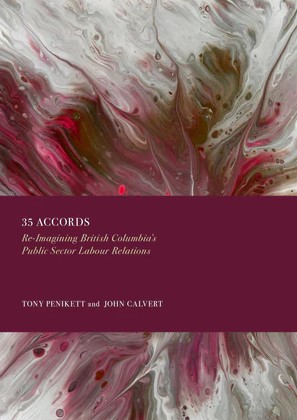
Coming soon are two books about negotiations in Canada, one 35 Accords (June 2025) about public sector bargaining and the other Treaty Time (May 2025) about Indigenous treaty and self-government compacts also implementation failures. Reviewers who would like to receive copies of one or both, should write to me at: tony.penikett@gmail.com
What does a cash-strapped government do when the collective agreements for almost a quarter million of its unionized employees expire simultaneously while wishing to maintain a respectful relationship with its labour supporters? In 1997, BC’s Premier Glen Clark proposed an imaginative solution. It was to offer unions an opportunity to participate with the government in developing policies on issues affecting their members and the services they provide. This became BC’s public sector policy accord process. The goal was to establish more collaborative relationships with unions, ones in which they had a voice in shaping policy solutions. This parallel process – largely separate from collective bargaining - would also avoid the adversarial relationship that so often characterizes a government’s relations with its unions, by recognizing the positive role unions and their members could play in improving BC’s public programs and services.
Clark recognized that all governments confront a large shopping list of potential policies. However, they can only legislate a small number during a term in office. Policy changes of interest to unions - and sometimes their employers as well - rarely get to the top of the shopping list. Clark felt that his accord process could enable unions to negotiate policy changes they felt would benefit their members and the services their members performed. The process would create a more respectful relationship between labour and government and make it easier for the latter to achieve its financial objectives. A key principle was that it was up to the unions, not the government, to identify the policy changes to be negotiated, based on their members’ concerns.
The accord process was different from collective bargaining. It included unions, government and, where appropriate, the public employers who would deliver accord policy changes. Unlike traditional labour negotiations which are characterized by an adversarial approach, it was explicitly focused on identifying mutually agreed policy changes. Accord negotiations did not involve arguing over money for union members: this was the role of collective bargaining and the government’s accord negotiators had no money to offer. Rather, the focus was on identifying cost neutral policy changes that would fix problems in the organization and delivery of public programs and services, while addressing issues of major concern to unions and their members – issues which often were legally outside the scope of collective bargaining. In the process, the accords were designed to improve the working environment for union members responsible for delivering public services.
Over an intensive three-year period, the parties negotiated 35 policy accords across the entire provincial public sector, including central government, crown corporations, agencies and municipalities. The accords covered a wide range of issues, including pension trusteeship and portability, early retirement, K–12 class size, benefits trusts, government procurement policy, hospital laboratory services, workforce training, pay equity, creation of a health and safety agency and numerous smaller policy fixes. A subsequent government attempted to roll back the accords. It legislated away some of them while choosing simply to ignore the policy commitments the previous government had made. However, some accords, like pension trusteeship were legally too complex to reverse. Also, some of the subsequent’ government’s legislative roll-backs were overturned by Canada’s Supreme Court, forcing the B.C. government to honour the previous administration’s commitments.
The accord process demonstrated that it was possible for a government to build more cooperative relationships with its unions by inviting them into the policy process. The accords definitely improved relations with the government and contributed to collective bargaining settlements within the government’s money mandate.
Posted: May 13, 2025