
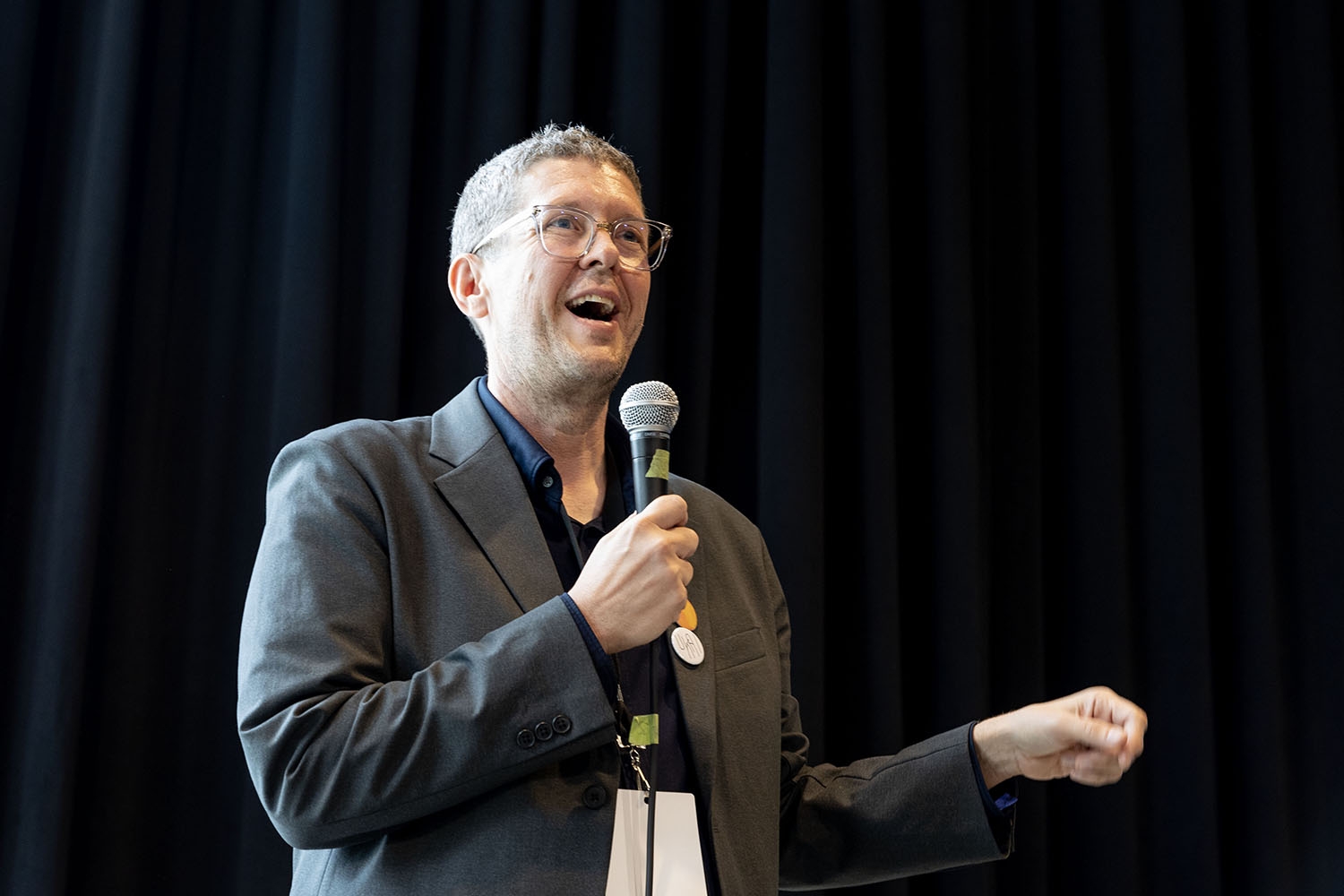
Jerrold McGrath is a cultural programmer, researcher, and writer based in Toronto. For eighteen years he has made residencies, festivals, national consultations, and multi-day encounters that place people inside artificial intelligence, ecological damage, and political uncertainty rather than in front of descriptions of them.
Work has been presented at Hebbel am Ufer in Berlin, the Edinburgh Festival Fringe, and SÍM Reykjavík, with commissions and partnerships across four continents.
He is the author of In Praise of Disorder and Poetics of Synthetic Language, and his research has been published by Springer and Edward Elgar. He founded UKAI Projects in 2017 and was Executive Director of the Japanese Canadian Cultural Centre from 2025 to 2026. He writes every second week at Poor Footing.
The world feels chaotic. We deal with this feeling by investing greater and greater energy into controlling what happens next. However, the broader and inescapable forces of entropy mount. Eventually, that energy will be released. Will we be ready?
Algorithmic systems promise even greater stability and predictability but, in the process drive out other ideas and beliefs in favor of the single-minded pursuit of growth and efficiency. What is lost in the process?
What if rather than fearing disorder, we embraced it? This presentation is an invitation to celebrate disorder as a practice that helps us deal with what’s coming. Rather than redesigning the world to feel safer, we can create and preserve a culture that acknowledges disorder while cultivating local and small-scale moments that help us adapt to changing conditions.
Disorder deserves praise. It helps us imagine new stories and conceptual metaphors, diversifies the solutions we draw upon in response to change, and liberates us from the relentless pace of modern life. Through practices of lingering, interrupting, theorizing, ritualizing, and beating the bounds, we can each break down the categories by which we make sense of experience and imagine new ones that are better suited to the world we’re in.
Poetics of Synthetic Language
Much of the debate around large language models has centered on the processes by which these models are trained and the relative quality of the outputs that they support. However, we must consider a future where the volume of synthetic language produced by machines will quickly outstrip that produced by human beings. What happens when water is only available from a tap or in a bottle? What happens when the fruits available to us are limited to only those easily delivered to a supermarket?
Verbal art must now contend with the introduction of an intermediary, akin to a chisel for a sculptor or a cello for a musician. What does this intermediary allow? What does it restrict?
Poetics generally refers to how a work of prose art is constructed. While hermeneutics explores what a text “means”, poetics is concerned with the various elements that give a work shape. There are a range of schools of thought on how best to structure this inquiry. Some, such as the structuralists, believe that poetics can be systematic and objective. Others, such as Mikhail Bakhtin, see poetics as involving the ever-evolving processes of becoming, defined by polyphony and multiple consciousness brought into relationship with one another in service to authorial intentions.
The arrival of large language models presents both challenges and opportunities for those exploring the art of the written word and this workshop is intended to invite conversation and generate outputs to explore a rapidly changing world. I am curious about the degree to which an automated system allows for other values to be expressed, to detach from constraining contexts, or to open up connotations.
Do large language models arrest the perpetual becoming of language or introduce a new space for genres and forms to emerge?